

Neurotoxin Selection for New Injectors
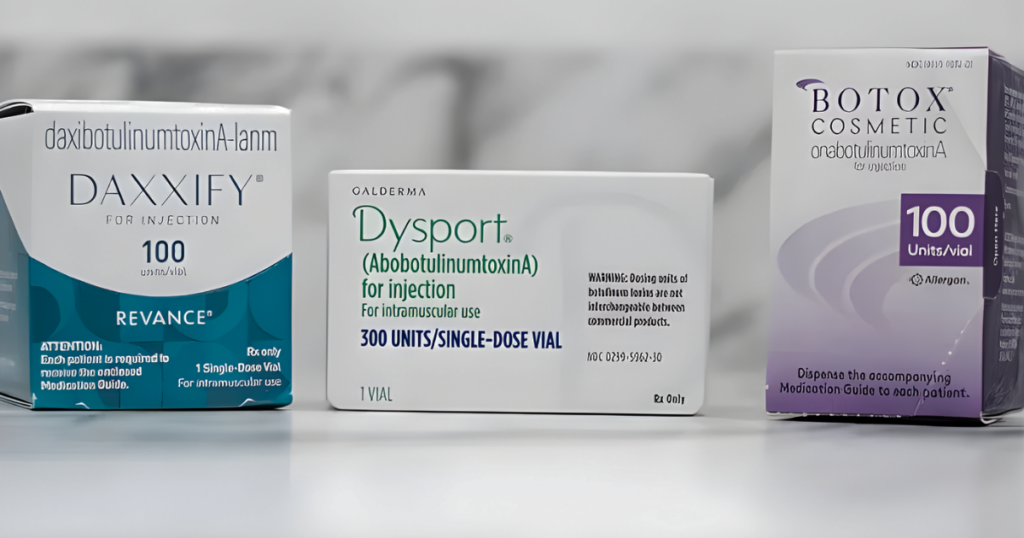
For new injectors, selecting a neuromodulator can feel overwhelming. The market offers multiple options such as Botox, Dysport, Daxxify and each comes with unique molecular characteristics, accessory proteins, diffusion profiles, and onset and duration patterns. Understanding these differences is not just academic; it directly affects how treatments are planned, executed, and tailored to patient anatomy.
At Aesthetic Pro Academy, we emphasize that safe, predictable, and aesthetically optimal outcomes begin with knowledge of product science and tissue behavior, not simply following marketing trends or popular choices.
Understanding the Basics: Neuromodulator Differences
All commonly used neuromodulators act by temporarily blocking acetylcholine release at the neuromuscular junction, causing predictable muscle relaxation. Despite this shared mechanism, their molecular structure, accessory proteins, and formulation vary significantly:
- Botox contains a 900 kDa neurotoxin complex with accessory proteins. These proteins stabilize the molecule and influence immunogenicity but also affect diffusion and duration. Its relatively large complex size tends to produce precise, localized effects, making it well-suited for targeted areas such as glabellar lines or lateral canthal regions.
- Dysport also contains accessory proteins, but its formulation results in smaller 500 kDa neurotoxin molecules that diffuse more readily. This property can be advantageous when treating broader areas or larger muscle groups, such as the forehead, but requires careful dosing and spacing to avoid unwanted spread.
- Daxxify is formulated without traditional accessory proteins. Instead, it incorporates a proprietary peptide-like structure that stabilizes the neurotoxin. This design contributes to its extended duration and faster onset, but its unique molecular composition of 150 kDa requires understanding of dosing equivalencies and anatomical response patterns compared with other toxins.
How Molecular Differences Affect Treatment
Differences in molecular size, accessory proteins, and diffusion patterns directly shape injection strategy. Injectors must understand these nuances to deliver safe, predictable, and aesthetically balanced outcomes.
Area of Effect: Smaller molecules like Dysport tend to spread further. This wider diffusion can benefit treatment of larger muscle groups but increases risk in areas that require high precision. Botox’s larger molecular complex remains more localized, making it ideal for targeted aesthetic corrections.
Onset and Duration: Daxxify uses peptide-based stabilization to extend duration and accelerate onset, which may allow patients to extend the interval between treatments.
Patient Anatomy and Muscle Dynamics: Each patient’s anatomy and muscle activity respond differently to neuromodulators. When injectors understand diffusion patterns, they can better predict outcomes, adjust dosing appropriately, and reduce the risk of unwanted effects.
In short, molecular differences are not theoretical. They directly influence treatment planning. When injectors master these nuances, they can anticipate tissue behavior, tailor treatments to each patient, and minimize complications, building clinical confidence and more predictable aesthetic results.
Why It Matters for New Injectors
For beginner injectors, it can be tempting to rely on a single neuromodulator without appreciating the nuanced differences between products. However, selecting the right neurotoxin for the appropriate muscle group, patient anatomy, and desired effect is essential for achieving natural, safe, and predictable results. Observing how each neurotoxin behaves in practice and integrating that knowledge into treatment planning, builds clinical confidence, improves patient outcomes, and fosters lasting trust.
At Aesthetic Pro Academy, our Botox Basics course provides a foundational, self-paced, didactic framework for understanding these differences. Students explore Botox history, mechanism of action, safety considerations, facial anatomy, and injection site strategy through detailed lessons and clinical case studies. Video demonstrations, downloadable treatment templates, and real-world scenarios allow learners to see how molecular properties, such as diffusion, accessory proteins, and peptide stabilization translate into treatment planning decisions. While hands-on practice is available as an optional add-on, the course’s primary focus is on building deep theoretical knowledge and clinical reasoning, equipping new injectors to make intentional, evidence-based decisions about product selection, dosing, and injection strategy rather than relying on assumptions or marketing claims.
This approach ensures that new injectors not only understand what makes each neuromodulator unique, but also how to apply that knowledge safely and effectively laying the foundation for a confident, thoughtful, and patient-centered practice.
Final Thoughts
Neuromodulator selection is far more than a product choice, it’s a clinical decision grounded in anatomy, molecular science, and patient-specific considerations. New injectors who understand the differences between Botox, Dysport, and Daxxify, and how these differences affect diffusion, duration, and area of effect, are better equipped to plan treatments safely and effectively.
At Aesthetic Pro Academy, we teach this knowledge alongside technique, patient assessment, and ethical decision-making, giving injectors the foundation to grow into confident, thinking practitioners.
🎓 Start your journey to becoming a thinking injector. Learn more about our courses, curriculum, and upcoming trainings at www.aestheticpro.academy
start Training with aesthetic pro academy
Take the Next Step


Hide