

Understanding Collagen Loss and Sculptra
One of the earliest patterns seen among new injectors is the tendency to associate visible aging with a need for additional filler. Patients present with flattening through the midface, softening of facial support, changes in contour, or diffuse facial deflation, and the instinct is often to restore what appears lost through immediate volume replacement. While volume restoration remains an important tool in aesthetic medicine, this approach can become limiting when structural aging is viewed solely as a problem of missing volume.
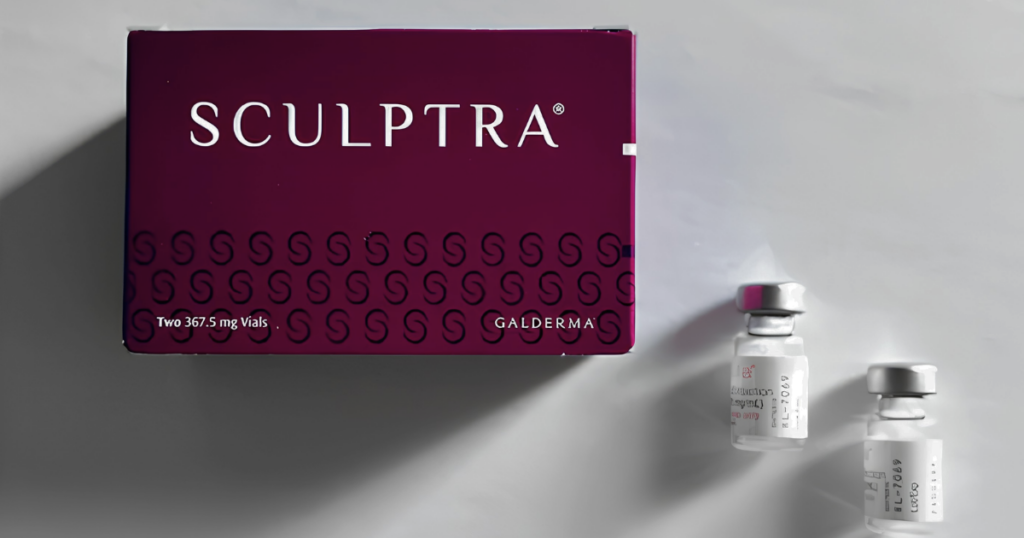
Understanding Collagen Loss and Sculptra challenges that way of thinking. Unlike traditional fillers designed to create immediate correction, Sculptra introduces a different treatment philosophy centered around tissue behavior and biologic response over time. Understanding how Sculptra functions clinically requires new injectors to think beyond placement and begin thinking in terms of structural change, collagen remodeling, and long-term support.
For many practitioners, Sculptra represents one of the first opportunities to transition from procedural thinking into true clinical reasoning.
Understanding Collagen Loss Beyond Volume Deficiency
Collagen is a major structural component within the dermis and connective tissue framework, providing support, tensile strength, and organization throughout facial tissue. Beginning early in adulthood, collagen production gradually declines while degradation pathways continue to increase. Over time, this process contributes to changes in skin quality, tissue thickness, elasticity, and overall structural support.
Patients rarely present describing a loss of collagen specifically. Instead, they report concerns such as appearing tired, looking older, or feeling as though their face has become “flat” or less supported.
Clinically, these concerns often manifest as diffuse facial deflation rather than isolated volume loss. Skin quality changes may coexist with support changes beneath the surface, creating a more global alteration in tissue behavior.
For newer injectors, distinguishing between true volume deficiency and structural tissue decline becomes important because these processes may require different treatment strategies.
Not every aging face requires more filler. Sometimes the greater clinical need involves improving tissue quality and supporting structural integrity over time rather than simply adding volume.
How Sculptra Works: Understanding Biostimulation Versus Replacement
Traditional hyaluronic acid fillers function primarily as space-occupying agents. Product is placed strategically to restore contour and projection with relatively immediate visible change. Understanding Collagen Loss and Sculptra requires recognizing that Sculptra functions differently.
Sculptra contains poly-L-lactic acid (PLLA), which acts as a biostimulatory material capable of initiating a controlled inflammatory response within tissue. Following treatment, the injected carrier solution gradually dissipates while PLLA microparticles remain, stimulating fibroblast activity and initiating neocollagenesis.
This process ultimately leads to gradual collagen production and tissue remodeling over time. One of the most important concepts for new injectors to understand is that Sculptra itself is not creating the final outcome.
The initial fullness observed immediately following treatment primarily reflects injected diluent and transient swelling. The visible result patients seek develops later through biologic response.
This distinction matters because Sculptra is not functioning as immediate correction. It is functioning as biologic stimulation.
Delayed Outcomes and the Importance of Patience
Sculptra often requires new injectors to become comfortable with delayed gratification, both for themselves and for their patients.
In many aesthetic treatments, providers receive immediate feedback. Product is placed and structural change becomes visible during the appointment itself. Sculptra does not provide the same experience.
Collagen production requires time. Fibroblast activity, extracellular matrix remodeling, and progressive tissue changes occur gradually across weeks and months rather than minutes.This delayed response can create challenges in clinical decision-making.
New injectors frequently feel pressure to chase visible correction too early, especially when accustomed to immediate outcomes with traditional fillers. However, adding treatment before biologic response has had adequate time to develop may lead to overcorrection or poorly structured treatment plans.
Patience becomes an essential clinical skill. Treatment progression should be driven by tissue response rather than anxiety surrounding immediate change.
Patient Selection: Not Every Patient Is a Sculptra Patient
Patient selection remains one of the most important components of successful Sculptra treatment planning. Patients experiencing diffuse facial volume loss, early structural decline, and generalized tissue changes often represent favorable candidates. Individuals seeking subtle progression and natural outcomes may also align well with treatment goals.
However, some patients may be less appropriate candidates. Patients seeking immediate correction before a specific event, those with unrealistic expectations regarding treatment timelines, or individuals presenting with isolated contour concerns may require different approaches.
One of the most important ethical responsibilities of an injector is recognizing when a treatment does not align with patient goals. Product selection should follow anatomy and treatment objectives rather than preference alone.
Safety and Tissue Behavior Considerations
Sculptra requires injectors to understand more than anatomy alone. Product preparation, tissue plane selection, dilution protocols, and distribution patterns all influence outcomes.
Because Sculptra acts as a suspended injectable material, placement patterns become particularly important. Superficial placement may increase the likelihood of palpable nodules or irregularities, while uneven distribution can affect tissue integration.
For new injectors, foundational priorities should remain focused on understanding facial support structures, respecting vascular anatomy, and learning how tissue behaves during the remodeling process. Technique develops with repetition. Judgment develops with understanding.
Becoming a Thinking Injector
Understanding Collagen Loss and Sculptra introduces a broader lesson within aesthetic medicine. Not every aging concern is solved through volume replacement alone.
Strong injectors learn to evaluate tissue quality, recognize structural change, and understand how biologic processes influence treatment outcomes over time. The goal is not simply learning where to inject. The goal is understanding why a treatment is indicated, how tissue will respond, and when restraint is more valuable than intervention.
At Aesthetic Pro Academy, we teach injectors to connect anatomy, product behavior, tissue response, and ethical clinical decision-making into a framework that supports both patient safety and long-term professional growth.
If you’re ready to deepen your understanding of anatomy, treatment planning, and advanced clinical thinking, enroll at Aesthetic Pro Academy and continue building the foundation of an intentional injector. Tap below to explore our training options.
start Training with aesthetic pro academy
Take the Next Step


Hide